Built for Healthcare Organizations Governing AI in Regulated Environments

Onboard AI is designed specifically for health systems, academic medical centers, and payers adopting AI at scale. We support the leaders and teams responsible for ensuring AI tools are evaluated, deployed, and monitored with discipline and accountability.

Cross-Functional Leadership in Healthcare AI Governance

No single team owns AI governance in healthcare-- yet everyone shares responsibility for its outcomes.
Leadership, committees, compliance, and clinical teams must align before tools move forward. Onboard AI creates the coordinated framework that turns that alignment into durable infrastructure.
Enterprise-Grade Governance Without Slowing Innovation
Onboard AI gives executive leaders a consistent, system-wide framework for evaluating and deploying AI tools. Governance becomes standardized across departments, without creating bottlenecks. Leaders gain visibility into risk, ownership, and oversight while preserving operational momentum.
Clear Structure for Efficient, Disciplined Review
Onboard AI replaces fragmented documentation and repeated context-building with a shared, structured review environment. Committee members can contribute asynchronously and arrive at meetings prepared. Alignment improves because everyone works from the same record.
Documented Mitigation and Audit-Ready Oversight
Onboard AI embeds risk identification, mitigation tracking, and regulatory alignment directly into the evaluation process. Documentation is structured, accessible, and reviewable. When scrutiny arises, the rationale and safeguards are already captured.
Implementation Clarity Without Guesswork
Onboard AI ensures clinical and operational input is formally documented during evaluation and preserved through deployment. Intended use, safeguards, and workflow considerations remain visible. Expertise won’t be lost after the meeting ends.
Health System Leadership
Enterprise-Grade Governance Without Slowing Innovation
Onboard AI gives executive leaders a consistent, system-wide framework for evaluating and deploying AI tools. Governance becomes standardized across departments, without creating bottlenecks. Leaders gain visibility into risk, ownership, and oversight while preserving operational momentum.
AI Oversight Committees
Clear Structure for Efficient, Disciplined Review
Onboard AI replaces fragmented documentation and repeated context-building with a shared, structured review environment. Committee members can contribute asynchronously and arrive at meetings prepared. Alignment improves because everyone works from the same record.
Compliance, Risk & Legal Teams
Documented Mitigation and Audit-Ready Oversight
Onboard AI embeds risk identification, mitigation tracking, and regulatory alignment directly into the evaluation process. Documentation is structured, accessible, and reviewable. When scrutiny arises, the rationale and safeguards are already captured.
Clinical & Operational Stakeholders
Implementation Clarity Without Guesswork
Onboard AI ensures clinical and operational input is formally documented during evaluation and preserved through deployment. Intended use, safeguards, and workflow considerations remain visible. Expertise won’t be lost after the meeting ends.

Committee-Based Governance in Practice

AI oversight in healthcare depends on cross-functional collaboration. Clinical, technical, legal, operational, and executive perspectives must converge before tools move forward. Onboard AI supports structured, shared review so decisions about AI adoption are transparent, coordinated, and durable.
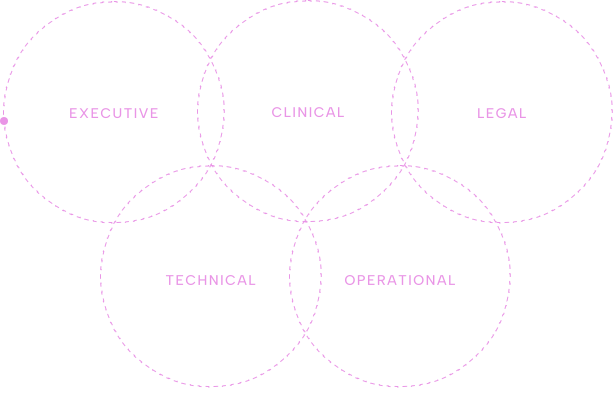
Executive, clinical, legal, technical and opperational

Infrastructure That Connects Governance Across Functions

Onboard AI bridges leadership, committee review, compliance oversight, and clinical implementation within one coordinated governance framework. It doesn’t replace these functions. It provides the structured system of record that keeps them aligned.

Centralized Governance Record

All evaluations, mitigations, and deployment conditions are captured within one authoritative platform. This reduces fragmentation across departments.

Cross-Functional Visibility

Clinical, IT, legal, and operational stakeholders work from the same structured documentation. Transparency improves alignment and reduces rework.

Lifecycle Oversight Infrastructure

Governance extends beyond deployment. Monitoring triggers, reassessment requirements, and ownership remain visible over time.


Health System Leadership
How does Onboard AI standardize AI governance across multiple hospitals or departments?
Onboard AI provides a centralized system of record with standardized but customizable intake, evaluation, and lifecycle oversight workflows. Health systems can enforce consistent governance expectations enterprise-wide while tailoring requirements by risk level, clinical context, or facility.
Can the platform support both vendor-provided and internally developed AI tools?
Yes. Onboard AI supports third-party vendor tools, internally developed models, and enterprise platform releases within the same structured governance framework. All AI systems move through a consistent intake and review process.
How does Onboard AI reduce executive time spent on repeated review cycles?
Structured intake, risk-based triage, and asynchronous committee review reduce unnecessary meetings and repetitive documentation requests. Executives review complete, standardized records rather than fragmented materials.
Does Onboard AI integrate with existing GRC and IT risk management systems?
Yes. Onboard AI complements existing GRC and ITRM infrastructure rather than replacing it. Governance data connects across systems without creating parallel workflows.
How does the platform preserve governance continuity during leadership transitions?
Every AI tool accrues a persistent, longitudinal record of evaluation, mitigations, and oversight requirements. Institutional memory is preserved within the system of record rather than relying on individual leaders.
AI Committees
How does Onboard AI structure committee-based AI review workflows?
Onboard AI structures review around a Canonical Product Profile, a longitudinal governance record that captures intake, assessment, model testing, and post-deployment monitoring within one evolving profile. This record produces a standardized Final Report delivered to AI Committees in a review queue, allowing members to focus on judgment rather than document assembly.
Can committee members contribute asynchronously between meetings?
Risk-based triage routes AI tools through different levels of scrutiny based on their clinical, operational, or financial impact. Lower-risk tools require proportionate review, while higher-risk tools receive deeper multidisciplinary evaluation.
How are AI evaluation frameworks applied in practice?
Yes. Stakeholders can review materials, provide input, and document concerns between live sessions. This reduces meeting time while improving preparedness and alignment.
How are deployment conditions and mitigation plans documented?
Conditions of use, safeguards, and mitigation requirements are formally captured within the AI tool’s canonical record. Ownership and follow-up expectations remain visible throughout the lifecycle.
How does the platform reduce repetitive information gathering?
Onboard AI reduces repetitive information gathering through standardized, configurable intake and evaluation workflows that eliminate informal back-and-forth. Canonical Product Profiles can also include prior assessments shared with vendor permission, allowing institutions to build on existing governance work rather than duplicate it, while maintaining independent review and accountability.
How are reassessment triggers managed over time?
Reassessment can be prompted by defined review intervals or material changes identified by governance teams. Organizations determine when renewed evaluation is appropriate based on their risk posture and operational context. All reassessment activity is documented within the same longitudinal governance record.
Compliance, Risk & Legal
How does Onboard AI align with healthcare regulatory standards such as CHAI and NIST?
Assessments are customizable and aligned with recognized healthcare frameworks including CHAI, NIST, Joint Commission guidance, and applicable state and federal requirements. Evaluations are structured around the standards healthcare organizations are building consensus around, helping governance processes stay aligned with evolving expectations.
How are risk mitigations documented and tracked over the AI lifecycle?
Risks are mapped to both operational safeguards and recommended contract provisions. Operational mitigations define how the organization manages risk internally, while contract provisions help ensure legal protections align with identified exposure. Both are linked directly to documented risks and preserved within the longitudinal governance record.
Can documentation be exported for audit or regulatory review?
Yes. Governance records can be accessed and exported to support internal audits, board reporting, or external regulatory review. Documentation is structured for clarity and defensibility.
How does the platform support defensible AI deployment practices?
By providing an easy, structured intake process, Onboard AI reduces shadow AI usage by giving teams a clear path to bring tools forward for evaluation, before deploying them into real world setting. Deployment conditions, mitigation plans, and oversight requirements are formally documented, creating a durable record that supports defensible AI adoption.
How does Onboard AI reduce exposure from informal governance processes?
By replacing slide decks, email threads, and fragmented documentation with a structured system of record, Onboard AI reduces ambiguity and strengthens oversight discipline.
Clinical & Operational
How does Onboard AI capture clinical context and intended use during evaluation?
Intake and assessment workflows require documentation of intended use, patient population, scope limitations, and operational considerations. Clinical expertise is formally incorporated into the governance record.
Can workflow and operational considerations be documented in the review process?
Yes. Operational feasibility, integration impact, and workflow changes are evaluated alongside clinical and regulatory considerations within the same structured assessment.
How are scope limitations and safeguards preserved after deployment?
Deployment conditions and safeguards are recorded within the Canonical Product Profile. This ensures governance teams can reference original evidence, risks, mitigations and contract provisions over time.
What happens when an AI system changes version or functionality?
Version releases, autonomy shifts, or functional updates can trigger structured reassessment. The governance record evolves as the AI system changes.
How does ongoing monitoring support safe and appropriate implementation?
Configurable monitoring triggers ensure that assumptions, risk levels, and safeguards are periodically reviewed. Oversight remains active rather than static.