Run governance from intake, assessment, approval, monitoring and reassessment on one durable record.





Most organizations can show they followed a governance process. Far fewer can clearly demonstrate why a specific AI tool was deployed, under what conditions it operates, and how identified risks are being mitigated. Onboard AI creates durable, reviewable records that make AI deployment structured, transparent and defensible.
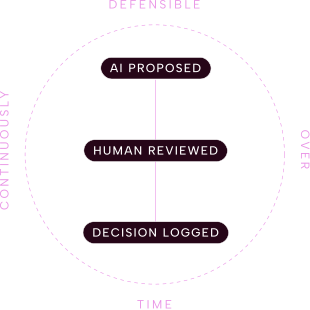
Each evaluation brings clinical context, regulatory exposure, financial considerations, and operational impact into a single structured record. Instead of reconstructing history through emails and slide decks, committees work from a shared, complete view of the facts. When questions arise later, the rationale is already documented.
Approvals aren’t vague endorsements. They include defined responsibilities, mitigation requirements, and follow-up expectations. Risk acceptance is clearly assigned at the time of approval, reducing ambiguity about who owns what. Accountability becomes visible, not implied.
AI governance shouldn’t depend on individual leaders or temporary committees. Onboard AI preserves precedent across leadership transitions, regulatory shifts, and evolving priorities. Approvals remain reviewable and defensible long after the original meeting.
AI oversight doesn’t begin and end with approval. It’s a continuous lifecycle that starts at intake and extends through monitoring, reassessment, and retirement. Onboard AI manages that lifecycle within one coordinated system so governance remains disciplined over time.
AI projects are routed based on risk and impact, ensuring the right controls are being evaluated against the right AI tools and lower-risk tools do not unnecessarily occupy committee time.
Assessments are customizable and aligned with recognized standards such as CHAI, NIST, Joint Commission guidance, and applicable state and federal requirements. Reviews are built around the frameworks healthcare teams trust, making clinical, regulatory, and financial tradeoffs explicit from the outset.
Approval isn’t treated as a permanent state. Conditions of use, contextual assumptions, and oversight triggers are tracked over time. When risks, versions, or regulations change, reassessment happens within the same structured system that governed the initial approval.
When AI oversight is structured, it becomes predictable, efficient, and scalable. Onboard AI reduces coordination burden while preserving rigor internally and externally.

Structured intake and asynchronous contribution reduce repetitive context-building. Committees spend less time gathering information and more time exercising judgment. Senior leaders engage where decisions are required, not where documentation is incomplete.

AI enablement teams want to run a process that reflects institutional competence. Onboard AI gives AI developers a powerful evidence collection and processing tool with clear evaluation criteria from the outset, so vendors respond to clear expectations instead of fragmented follow-ups. Review cycles move faster without lowering standards.

Onboard AI complements existing GRC and ITRM systems rather than replacing them. Governance records integrate across enterprise infrastructure without creating parallel workflows. Organizations can formalize AI oversight without operational disruption.



Not generic AI governance. Not retrofitted GRC. A healthcare-native system of record.
People at the Center
Empower multidisciplinary committees with shared context, defined responsibility, and clear ownership of risk.
End-to-End Process
Govern the full AI lifecycle, from intake through monitoring and reassessment.
Automation That Removes Busywork
Replace spreadsheets and slide decks with structured workflows that reduce rework without reducing rigor.
When AI oversight is structured, it becomes predictable, efficient, and scalable. Onboard AI reduces coordination burden while preserving rigor internally and externally.
“Responsible AI isn't just about speed - it's about trust. With Onboard AI, we're scaling innovation by ensuring every solution meets our rigorous standards for safety and ethics. That's how we build confidence in the future of healthcare.”
“After looking at AI governance solutions across the market we picked Onboard AI because they really understand the challenges healthcare organizations have when it comes to implementing AI. Their approach as an end-to-end system of record, from intake to monitoring, is unique and incredibly valuable as we ramp up AI initiatives across our organization—without compromising the security or safety of the people we serve or the hard-working team members and field staff who support that care.”